
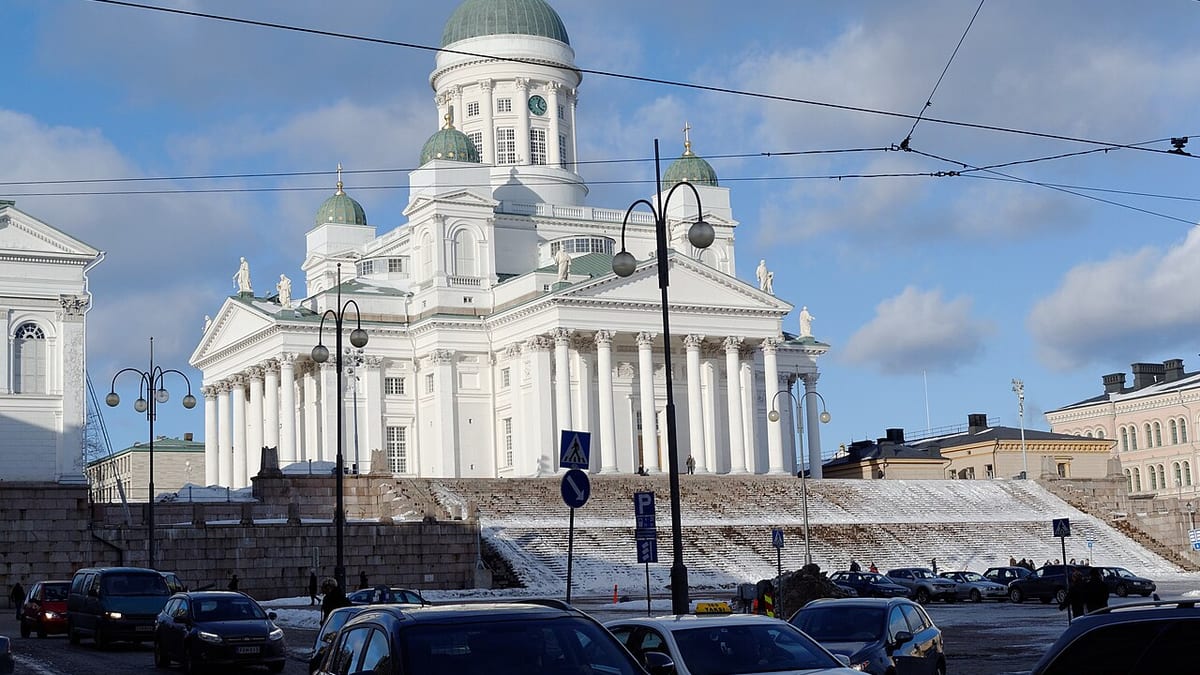
Helsinki in November suits travellers who enjoy museums, design, cafés and evening performances more than a packed outdoor sightseeing schedule. Plan for damp cold rather than guaranteed snow, keep your longest walk in daylight, and give each day a substantial indoor anchor. The city works well in this season when you stop trying to visit it as though it were July.
What November weather actually means for your trip
The Finnish Meteorological Institute's 1991–2020 November normals give Helsinki's Kaisaniemi station a monthly mean temperature of 2.4°C and precipitation of 69 millimetres. These are long-term averages, not a prediction for November 2026 and not a daytime high. They describe a month in which a waterproof outer layer deserves at least as much thought as a warm one. [1]
Avoid building the trip around snow-covered streets. Choose activities that remain worthwhile with bare pavements, rain or a mixture of conditions. A white landscape would be a bonus, not the condition that makes your booking worthwhile. Likewise, do not interpret a relatively mild forecast as permission to spend hours motionless beside the harbour without additional layers.
The practical issue is cumulative exposure. A short walk between a café and a museum is one thing; repeated waits at tram stops followed by an extended waterfront stroll are another. Plan the day in blocks so that you can warm up properly rather than spending the afternoon slightly uncomfortable and buying emergency clothing.
Use the forecast near departure to refine the suitcase. A climate average helps choose the type of trip; it cannot determine whether your particular Tuesday needs an umbrella, additional insulation or a shorter outdoor route. Keep at least one flexible half-day instead of assigning every activity to a non-refundable time slot.
Pack for transitions between outdoors and indoors
A practical combination is a comfortable base layer, an insulating middle layer and an outer layer that handles wind and rain. Add a hat, gloves and shoes you can walk in confidently on wet surfaces. The point is adaptability: you should be able to remove a layer in a warm gallery without carrying a second bulky coat.
Give footwear priority over a photogenic winter outfit. Try shoes with the socks you intend to wear, and leave room for drying them overnight. A spare pair of socks takes little space and can rescue an afternoon after an unexpectedly wet walk. Keep a small bag for damp items so they do not share space with books or newly bought ceramics.
A compact umbrella may be useful in sheltered streets, but do not make it your only rain protection. Take a small day bag that closes securely and protects your phone and tickets. For museum-heavy days, choose a bag you can comfortably leave in a locker when required, rather than something containing everything you might conceivably need.
Removable traction accessories need an indoor plan too. Amos Rex specifically does not allow studded shoes on its wooden floors and offers protective alternatives. That is a useful reminder to think about the whole day, not just the pavement outside. [2]
Put one strong indoor visit at the centre of each day
Oodi is an especially easy first stop because basic entry does not require a library card. Its tourist information explains that visitors can explore the building and use facilities such as the public Wi-Fi. Treat it as a functioning public library, not merely a photo location: leave time to sit, orient yourself and enjoy the building without turning it into another hurried attraction. [3]
Amos Rex provides a more substantial paid cultural anchor. Its autumn 2026 exhibition period began on 14 October, after the installation closure, so advice describing it as closed through early autumn is no longer applicable. The museum is normally closed on Tuesdays; its visitor page also lists a shorter closing time on 30 November 2026. [2]
For adults, the published admission is €20 online versus €22 at the museum, with different eligibility-based prices for younger visitors and students. The practical saving is modest, but online booking can also help you choose the shape of the day. Buy the ticket for an exhibition you genuinely want to see rather than assuming every art museum offers interchangeable content. [4]
Arrange an outdoor segment before or after that fixed visit, not two distant attractions on either side. For example, an architectural walk, lunch and one exhibition can make a satisfying day. You do not need to add another museum simply because the weather has discouraged a longer stroll.
The harbour is still possible; summer cruises are not the default
Suomenlinna remains accessible on the year-round HSL ferry. The crossing from the Market Square takes about 15 minutes, and access to the fortress itself does not require a general entrance ticket, although individual attractions can charge separately. A ferry ride and a carefully chosen island walk can therefore work outside the summer sightseeing season. [5]
That does not mean every boat trip advertised in an older Helsinki guide runs in November. Stromma's published 2026 Beautiful Canal Route season ran from 1 May to 30 September. Its sightseeing cruise should not be presented as a November option simply because the booking page remains online. [6]
Choose Suomenlinna for the island visit, not as an identical substitute for a narrated archipelago tour. Keep the outing adjustable: decide which part of the island you actually want to see, allow for the return ferry and avoid letting a late departure consume the best part of the day. A short, comfortable outing beats an ambitious route completed only because it was written into the itinerary.
For a very wet or windy day, move the island trip rather than forcing it. The harbour can still provide a brief sense of place from the city side, followed by a café or indoor visit. Reserving this decision until you have a useful forecast is a sensible use of flexibility, not poor planning.
Use the evening rather than trying to extend the afternoon
A concert can give November a structure that summer sightseeing does not need. Musiikkitalo's programme includes different kinds of events, while its visitor information explains arrival, cloakroom arrangements and what happens to latecomers. Choose the performance first, then book dinner around the published start time rather than hoping a rushed meal will finish conveniently. [7]
For an inexpensive evening, a café, a relaxed dinner and a short illuminated city walk can be enough. Avoid booking every night in advance unless you particularly value the events. Travelling in a darker season does not require constant entertainment; it rewards choosing a few places where you are happy to spend longer.
Do not assume that a Christmas market or seasonal installation operates throughout November. The month is not a single festive season with identical opening dates. Only build an evening around a named event once its own dated programme confirms that it overlaps your visit.
A realistic two-day rhythm
On the first day, keep the morning central: explore the streets around your accommodation, continue to Oodi, then use lunch to decide how much outdoor time feels comfortable. Put the main museum visit in the afternoon and leave the evening for a concert or an unhurried meal. This arrangement makes the first day useful even after a tiring arrival.
On the second day, use the better weather window for the harbour or Suomenlinna. Keep a central shopping or gallery alternative ready, with opening days checked for the actual date. Finnish design shopping works best when you allow time to compare objects rather than treating it as a five-minute souvenir stop.
Choose accommodation for the journeys you will actually repeat: returning after dinner, reaching transport with luggage and finding breakfast nearby. A bargain requiring several extra transfers may be less attractive in November than a modest, well-positioned room. The strongest itinerary is not the one with the most pins on a map. It is the one that lets you enjoy Helsinki without spending half the trip recovering from the weather.