
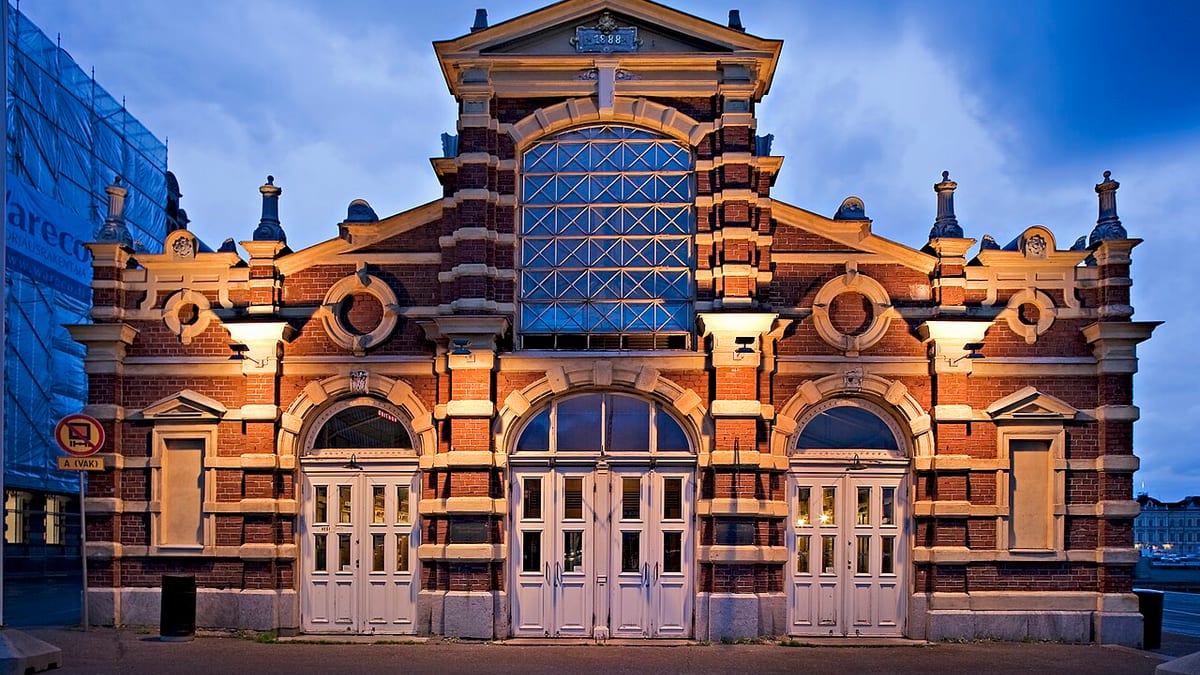
Helsinki's Old Market Hall is worth a stop when you are near the harbour and want food shopping, a modest meal or a look inside a historic market building. It is less compelling as a special journey for someone seeking the city's cheapest lunch. Visit during the service hours of the business you want - not merely before the hall itself closes. [1][2]
A food stop with history, not a full-day attraction
The hall stands beside Market Square and has served customers since 1889. Its operator explains that construction began in 1888, the year visible on the building, while the opening followed a year later. That small distinction is useful when different guides appear to disagree about its age. [3]
The building is part of the experience, but it is still a working place to buy and eat food. Approach it as a market rather than as an exhibition where every counter exists to entertain visitors.
A brief browse can be worthwhile without a purchase. A longer visit makes more sense when you choose lunch, coffee or something for a picnic. As a planning suggestion, allow a short stop for browsing and more time if you intend to sit down; there is no reason to allocate several hours simply because the building appears on a sightseeing list.
It fits particularly well into a harbour walk. The attraction is the combination of location, interior and food, not an expectation that it will rival a large food market with many separate halls.
Decide what sort of meal you want before joining a queue
The hall's operator describes counters selling fish, shellfish, cheese, meat, produce, spices, coffee and other goods. It also highlights salmon soup and fish sandwiches among the familiar food choices. [3]
Those categories do not all represent ready-to-eat meals. A display of fresh fish may be a shopping opportunity rather than lunch; a small sandwich may suit a snack better than a hungry afternoon. Look at what is actually included before comparing prices.
SOUP+MORE provides a useful transparent example. Its published price list shows vegetable soups at €12, meat soups at €13 and fish soups at €14, with optional additions priced separately. Menus rotate, so use those figures as the operator's current category prices rather than a guarantee of one particular recipe every day. [2]
For two people choosing fish soups at that listed price, the food total would be €28 before any extras or drinks. That calculation is more useful than describing the hall vaguely as either "cheap" or "expensive."
Story is another option for a sit-down café-restaurant experience in the hall's central area, as identified by Helsinki's tourism guide. It is a different proposition from buying a snack to carry away. Choose according to how you want to spend the break, not simply which name appears first in a recommendation list. [4]
Dietary requirements need a conversation with the individual business. A market with varied counters may offer choices, but variety is not proof that a particular dish avoids an allergen or that preparation areas are separate.
Building hours do not equal kitchen hours
The hall lists regular opening Monday–Saturday, 08:00–18:00, with an explicit warning that vendors may use different hours. This is the first timetable to check, but not the last. [1]
SOUP+MORE's Old Market Hall service, for example, is listed as 11:00–16:00 Monday–Saturday, closed Sunday. Arriving at 17:00 because the hall closes at 18:00 would therefore be a poor plan for that particular lunch. [2]
This is not unusual or deceptive; a shared building and its individual kitchens serve different functions. It simply means a guide should not advertise the hall's closing time as if every meal remains available until then.
For a weekend, place the hall on Saturday unless a specific Sunday opening has been announced for the venue you intend to use. Do not treat a special holiday opening from a previous date as the normal weekly timetable.
A late-morning visit can work when you want to see the counters and then eat. A quick morning browse may also suit you, but it should not rely on a lunch kitchen being ready as soon as the doors open.
Combine it with the harbour without rushing the meal
The hall is especially convenient before or after a Suomenlinna outing. Its operator explicitly identifies the nearby Market Square ferry as a reason to buy food for the island. [3]
That convenience can become a trap when you try to order a sit-down meal just before a departure. Decide which matters more: catching that particular ferry or enjoying lunch. If the meal is the priority, take a later boat rather than carrying a clock through the whole experience.
For a picnic purchase, choose food that travels well and is appropriate for the weather and the time before eating. Ask the vendor about storage when buying something perishable. A hot soup may be a comfortable indoor lunch but less convenient than a securely packed sandwich on a moving boat.
You can also visit after the island, provided the food business is still serving. In the colder months, planning the hall for lunch before the ferry is often easier than assuming a late return will leave every counter open.
A central-city walk can use the hall as its meal stop without any island excursion. The aim is to reduce unnecessary travel, not to make a food market the compulsory starting point for every Helsinki day.
Is it touristy, and does that matter?
A central location and a place in sightseeing guides do not automatically make a market poor value. Equally, a historic interior does not prove that every purchase is locally made, traditional or competitively priced.
Judge the individual item. Look at the ingredients, portion size, origin and displayed price. For a gift, ask where it was produced rather than treating the setting as a certificate of provenance.
The tourism authority distinguishes the Old Market Hall from Hakaniemi's market hall and other Helsinki food destinations. That creates an alternative for someone who enjoys markets enough to compare them, but it does not establish that one is universally more "authentic." [4]
For a short first visit, the Old Market Hall's location can be its biggest advantage. For a longer food-focused stay, visiting another hall may give you a broader picture. There is no need to turn the choice into a competition between tourists and residents.
The best way to use the stop
Choose the Old Market Hall when it complements a harbour itinerary and you want a particular meal, food purchase or architectural look. Read the menu before ordering, respect the working counters and keep the visit proportional to your interest.
Skip a dedicated detour when you are far away, short on time or primarily hunting the lowest lunch price. A convenient café or supermarket may solve that need better.
The hall is most rewarding as a useful part of the day: a warm bowl of soup, a browse among food counters and a historic setting that adds character to an ordinary meal. With the kitchen hours understood, it is an easy stop to justify.
Source & editor notes
Hall hours and history are from its operator; the soup prices and shorter kitchen hours are vendor-specific. The two-person total is calculated. Recommendations concern fit and convenience, not firsthand tasting or a cheapest-price ranking.