Hvitträsk is worth visiting for architecture and design enthusiasts who want to explore a National Romantic studio home in its landscape. It is less compelling as an improvised excursion without transport planning. The museum is currently closed for winter and announces reopening on 1 May 2027; its November Christmas market is a separate event. [1]
Why this house is more than a pretty exterior
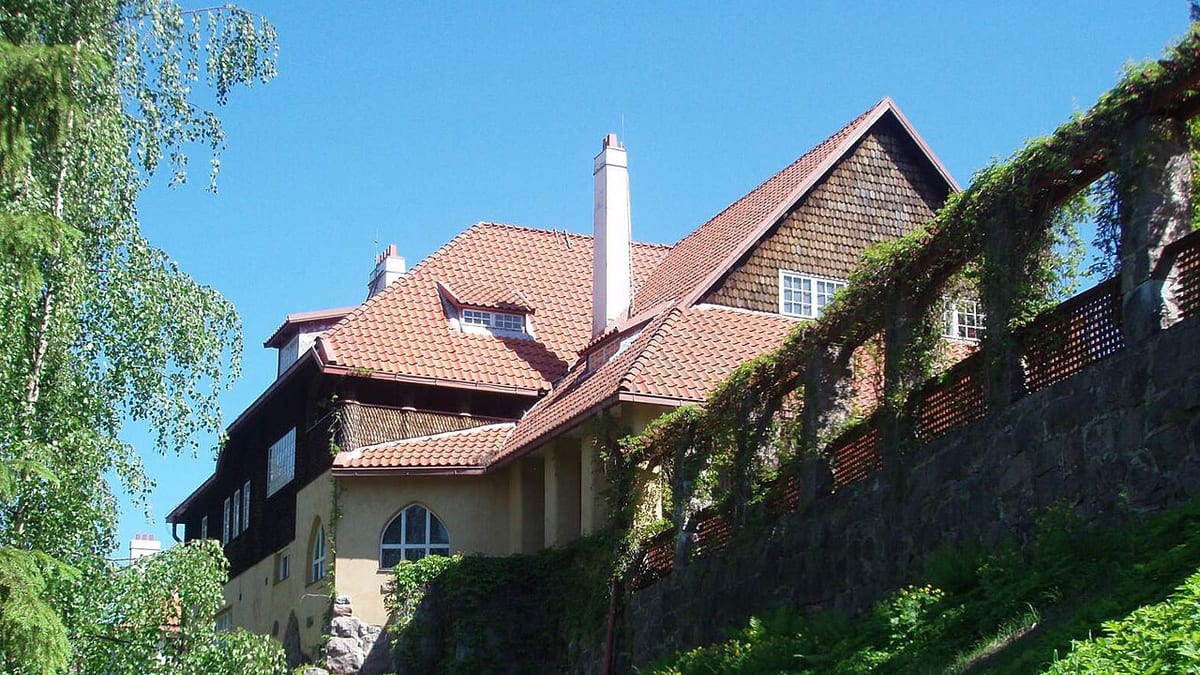
Completed in 1903, Hvitträsk was created by architects Herman Gesellius, Armas Lindgren and Eliel Saarinen as both a home and a workplace beside Lake Vitträsk. The National Museum describes it as a total work of art: architecture, interior design and setting are intended to be understood together. [1]
That is the most useful way to approach the visit. Rather than looking only for a celebrated room or an attractive photograph, ask how domestic life and professional work fitted into the same place. Notice the relationship between spaces and the landscape outside. The appeal is cumulative, built from those connections rather than one enormous ceremonial interior.
Hvitträsk makes particular sense after seeing architecture in central Helsinki. The change of setting lets you compare a building designed for public use with a place conceived around its creators' own lives. You do not need to know the architects' entire careers beforehand, but a little curiosity about how a house can express ideas will make the visit richer.
It is not a general-purpose country estate day with unlimited entertainment for every interest. Someone who enjoys gardens but has little interest in the house may prefer a simpler garden outing. Someone fascinated by interiors and design may find the relatively focused experience precisely the reason to come.
The season determines whether the trip works
The museum's current notice is unambiguous: regular visits have finished for the season, with reopening scheduled for 1 May 2027. The published 2026 operating pattern was Wednesday to Sunday, 11:00–17:00, from May through September. That completed-season timetable is useful context, not a verified schedule for every day of 2027. [1][2]
For travellers already in Helsinki in November, do not substitute an exterior excursion for an interior visit without deciding that the outside setting alone is enough. A long journey followed by a locked museum is not a bargain simply because the building can be admired from somewhere nearby.
The official site separately lists the Christmas market on 28–29 November 2026. It may give a reason to visit during the closed season, but a market listing should not be read as a promise that the normal museum route, guided tours and summer café arrangements all operate. Use the event's own conditions when planning that weekend. [1]
For a future summer visit, put the museum's opening day ahead of other flexible activities. It is easier to move a city shopping walk than to make a seasonal museum open on a Monday. This is especially relevant to a short stay that contains only one or two suitable days.
What the published prices tell you
For the 2026 season, ordinary adult admission was €15 at the museum or €14 online. Admission for ages seven to seventeen was €4 at the desk or €3 online, while under-sevens entered free. The published family ticket was €32 for two adults and one to four children. [2]
These figures are a benchmark for judging the scale of the outing, not a promise of 2027 pricing. The more significant budget question for an independent traveller is often the journey's final stage. A small saving on online admission may be outweighed by arranging a return taxi, so assess transport and entry together.
For a group, calculate the total trip cost per person rather than comparing only individual admissions. Sharing a prearranged vehicle may change the equation substantially. That does not mean a taxi is automatically the cheapest choice; it means the right comparison includes the number travelling, the actual route and the value of time saved.
The train does not deliver you to the museum
The official visitor page identifies Kauklahti railway station as approximately six kilometres from Hvitträsk. It also mentions a limited bus connection toward Luoman VPK followed by roughly two kilometres on foot. Neither description should be mistaken for a frequent, door-to-door museum shuttle. [2]
For a car-free visit, use the current journey planner for the exact date, then decide how to handle the final leg. Do not select a train solely because it reaches Kauklahti at a convenient time. You still need a workable onward connection and, just as importantly, a return plan after the museum visit.
A booked taxi arrangement can make sense when the house is a high priority, but confirm collection details and the return rather than assuming a vehicle will be waiting outside. Give the driver the full museum address, Hvitträskintie 166, and agree on a meeting point that does not depend on mobile reception or a hurried phone call at closing time. [2]
For drivers, the museum lists free parking but warns that capacity is limited. Arriving early in the visiting window is preferable to building the day around the final available hour. The saving in admission from a pass is only useful when the visit itself remains comfortable and unhurried. [2]
A guided visit adds context, but booking rules matter
The published in-season public-tour schedule lists Finnish at 12:30 and English at 15:00, Wednesday to Sunday. These tours are included in admission, limited to twenty people and allocated first come, first served; advance reservations are not accepted for the ordinary public departures. Private tours are a separate arrangement. [3]
For an English-speaking visitor, that timetable affects arrival planning. Coming at opening and hoping an English public tour will start shortly afterward is not the same as planning around the listed afternoon departure. Allow time to see the setting beforehand, and arrive early enough to ask about that day's capacity and any changes.
The tour is particularly worthwhile when the relationships between architects, residents and rooms are what drew you to Hvitträsk. Independent exploration remains a valid choice when you prefer to concentrate on details at your own pace. Do not add a tour merely because it is included if its language or timing makes the day worse.
Access and the final decision
The museum clearly states that the building is not accessible: there are many stairs and no lift. Wheelchair users and anyone for whom stairs are a serious barrier should contact the museum about the specific areas that can be reached before making the journey. A garden visit should not be presented as equivalent to access to the house. [1][2]
I would give Hvitträsk a place in a longer Helsinki trip when design is a real interest and transport is settled in advance. I would not recommend it as a universal first-time must-see, or as a winter interior visit while the seasonal closure applies. Its value comes from spending time with a coherent work of architecture in its intended setting. Protect that experience with the right date and a workable route, rather than treating it as another pin on a map.